Saturday, 22 November 2014

Group Planning - Miss Georgiou

My group consists of three girls; myself , Ella and Rishika. Each week we have a lesson where we have a group meeting and discuss the individual ideas we have created and gathered for our final thriller outcome. Group meetings are essential as they allow us to all communicate face to face and share our ideas on improvements for our planning. Also it allows us as a group to evaluate what we have done well and we could do better to make our thriller opening successful.The planning lays all the flaws and mistakes within our narrative, so this will make us prepared before carrying out the actual film because we will adjust to it which will allow to make our opening scene flow smoothly.


On the 17th October in my media lesson, me and my group sat down and discussed the different types of narratives we have all came up with and decided which narrative we wanted to do. The importance of the individual narrative is that it allows each member to create their own ideas on what they believe will be a good thriller. If we weren't to create individual narratives, each member will not explore their ideas and when creating the group narrative some may disagree with the others. When we finished making our own narratives we came as group and reviewed each narrative, deciding which one we will follow. This was helpful as it allowed us to listen to each others ideas and also make up more ideas to improve the final group narrative. Once me and my group finished discussing each individual narrative, we finally decided that we will follow my narrative. This is because we thought that my narrative conveyed many conventions in a thriller which will make the thriller opening a successful one as it provokes suspense, surprise and tension. 


Our meeting that commenced on the 4th November we discussed the Mise-en-scene that we will include in our thriller. On a piece of A3 paper we divided it into the 5 elements of Mise-en-scene( setting & iconography, costumes & hair and makeup, colour and lighting, body language & facial expressions and positioning. This was to show clearly what was each in their sub headings, once we did this we started filling out the aspects of the each box of what Mise-en-scene we were going to include in our opening thriller. This allowed us to discuss together as a group all the different ideas we all had that we all came to agree with that we thought that would make our thriller successful. For example in our plan we wrote under the subheading lighting, that we would use low-key lighting due to the setting being in the evening and explained what effect it had on the film and audience e.g creates suspense and tension because its dark and it makes it hard to see the antagonist. The planning helped clearly as we gathered the important parts of Mise-en-scene within our thriller which made us organised and at ease. 


On the Friday 7th November, me and my group in the lesson sat down and made a plan of the all the cinematography we were going to include in our thriller. This involved camera angles, movements and positions that we believed would help make the narrative more interesting and shocking. Planning the cinematography helped us portray the different perspectives from both our types of characters protagonist and antagonist i.e and also show which one was more dominant and vulnerable from the two. The planning of these shots were very important because it prepared us on what to include when filming our actual thriller and also helped us establish the different shots that we thought helped tell our narrative clearly. As we planned the cinematography when actually filming it wouldn't be chaotic and we will know what we have to include within our film as we followed the guideline of the plan. 


As sound is very crucial to thrillers we had to make sure we understood why and how we were going to include the sounds that we planned to occur in the scene. We all sat down and made four boxes and explained the four types of sounds we will include within our thriller sequence. We came up with at least a minimum of two sounds for each box because of the importance of sounds within in thriller we made sure we had enough that we believed will have an impact on our audience. The sounds we gathered helped us communicate with each other and evaluate which sounds we thought would have an effect on the audience and get a reaction from them emotionally which will hopefully want them want to carry on watching. An example of sound we decided to use was a non-diegetic sound which will occur on the chase scene where the girl is running in the forest. The scene will mirror her running away but also how the antagonist is getting closer which will create suspense and tension in the audience. 

In our lesson on the 10th November, we made another A3 plan for editing of all the editing styles that we would include in our thriller. Firstly we all looked back on our inspirations post that we made earlier and looked at the editing that we were inspired to use. One of our inspirations was to use a reaction shot, we decided to include this on our plan as we wanted to show a reaction shot within our thriller so that the audience can relate to the character and build a closer relationship with them. This was because the reaction occurred when the girl finds her friend dead on the floor on the road which was part of our narrative, the reaction shot establish her facial expressions and how she was feeling. Planning editing was important because when we actually were going to edit our thriller it will be less time consuming because we knew what we were going to include that'll help our opening more interesting and effective to watch. 


In this lesson on the 12th November we wrote down on a piece of A4 paper the characters we were going to include in our thriller that represented the two roles antagonist and protagonist. Due to our narrative we followed that to gain ideas of what our antagonist would be and how he would look. We came up as it is a thriller, he would be wearing dark clothing as dark colours create enigma due to the colourfulness. Also we discussed how our protagonist will look like what their backgrounds were, we decided to make our two protagonists as girls as this was conventional to a thriller and the audience will sympathise to them as their innocent girls. The planning of our characters allowed us all of us to communicate our ideas and merge them together to make sure our characters included were conventional to a thriller as much as possible. Finally because we have a flashback that includes a young boy we evaluated how this character would look like, but after discussing we came to an agreement to have the boys face hidden just like the antagonist. All of this created enigma and that was our aim for the audience was to feel suspense and tension whilst watching. The planning was good and we would refer back to it when we tell our actors what they will need to do to show their characters in our film and make them look more realistic. 


After this, we all individually made our own storyboards that we thought our narrative should follow. This was helpful as it all gave us a chance to express what we all thought the narrative should run in. The storyboard consisted of drawing and a brief explanation of each frame in our narrative of what we wanted to include. I found this very interesting because when we actually came together and discussed our individual storyboards mine and Rishikas were slightly the same. However Ella's instead of starting with the antagonist laying on the road, she decided to start our narrative with the flashback of the little boy on the swings. Me and Rishika were amazed with this idea and very much liked it. So in our group storyboard we decided to follow Ella's as it was more interesting to watch and it flowed easier so that the audience could understand what they're watching. If we were not to plan our own storyboards and firstly done it as a group we would of missed out everyones ideas that they initially had in mind at first, so I am happy we did the individual storyboards. 

Finally, our last planning session was on the planning of our opening credits we all went off individually and went on the macs to go on the software Final Cut Pro x where we were going to create our opening credits. We done it individually again so that it allowed us to each express our different ideas on what we thought would be good for our opening scene. Once we all had finished our own opening credits we showed each others one by one and explained what the effect it had on the viewers and the film itself. After this we all discussed the advantages and disadvantages of each opening credit so that we all understood where each an every member was feeling towards our creations. Lastly we all came to an agreement that Rishika's Opening credit was the best due to its interesting effects and colours the helped convey the different character representations within our scene. This was helpful because it made us all understand how our final opening credit was conventional to a thriller and how it was applicable to our narrative. 

Through all this group planning, I think it has helped me and my group understand everyones opinions and ideas on what they believed was best to include in our opening thriller to make it successful. It was interesting to see everyones own individual view of every element of our thriller. Without planning we would not know what to do when actually filming the thriller and it'll be chaotic making us stressed and not able to perform at our best. 

Planning Opening Credits - Miss Georgiou

Opening credits are shown at the very beginning and are a list of the most important members of the production. The order of the list usually starts with the director or the most famous actor/actress in the film, this is then followed with the title and then the rest of the members of the production. Credits are usually shown as text overlapped on a blank screen or static pictures, or sometimes on top of action in the show/film. Opening credits within a film are very important as the fonts, style and layout included is what helps convey and foreshadow what type of film the audience will be watching. In this post I will be evaluating the importance and techniques added to the opening credits from the film se7en. 


se7en opening credits

The beginning of the credits of se7en include a variety of extreme close ups of different objects, this gives the viewers an idea of what they re about to watch as it emphasises the size of the subjects. The use of the colour scheme of white and black helps convey that there is a contrast between both good and evil within the film, in a thrillers case protagonist and antagonist. Moreover, both colours represent meanings that juxtapose  each other e.g white represents life, goodness, hope and light. Whereas black represents darkness, mystery , power and death. The use of the two colours makes the scene calming and dull making the audience feel suspense to why the colours are so simple. Also at 0:36 - 0:38 the screen is filtered with the colour red over an image of a man in water, the use of the red filter foreshadows death, blood and murder in the film as red is associated with blood, fire, heat , desire and danger i.e. As the red filter comes unexpectedly this shocks the viewers as they are used to the white, black and greyish scenery that the film was portraying at first, this could imply that there may be an event that is unexpected and will shock the audience.
The Title 
The style of font within this opening credits is a font that mirrors a child's handwriting due to its lack of neatness, this could portray a character in the movie who has the mentality of a child so he could be a psycho in the film. When the actual credits are shown, the words are flashed into different sizes as they dissolve, this gives a 'trippy' visual which makes the audiences eyes widen as they don't expect it. The use of this could represent the mentality of the antagonist and show that his mind set is not balanced, this is conventional to a thriller as it helps portray the characters and make the audience understand a little more about them through the text. 
someone using a razor to peel their skin

The iconography shown in the opening scene of the se7en are sharp objects, drawings and pens etc , the use of these items imply that the person who is creating all of them is planning something that is dangerous which they'll use against their victims. In the scene, theres a hand shown and images but nothing else, this means that the person behind the camera does not want to be seen. The use of this hidden identity is conventional to a thriller as antagonists do not like to be seen as they like to have a surprising introduction in the film which shocks the victims and audience. However, as the audience cannot see who's behind the actions in the scene, they will create a distant relationship with who ever it is as they cannot trust them because they're not showing their identity which creates tension and suspense. The order of appearances and different production jobs are in the following : director, most famous actors names for example Brad Pitt and Morgan Freeman,  the title of the film which was shown in larger bolder text,  the other actors that aren't as important as the first two, casting, music  costumes , editors, production , director of photography, co producer, executive producer, written by, produced by and who the directer is again. In this film the name of the director is seen twice, this is because he may be known and they believe the audience will recognise his name due to watching his other creations, so this will be beneficial to the film as it'll produce more sales the more profit everyone makes.


Individual Opening Credit

Individually all of my group members went on the mac and went on the software Final Cut Pro to create our own individual credit that we believed would be suitable for our opening thriller. Firstly when I started creating my thriller I searched for the font I believed had a weird, child look handwriting feel to it. This was the font Nanum Brush Script because the font was clear but a bit crooked which I thought could mirror my antagonist state of mind as when he was child he was traumatised so the font could represent him mentally.  After this I selected the colour font I wanted the writing to be, I decided to use the colour which will be seen on a black screen. The use of this is conventional to a thriller as it extinguishes the "good vs evil "( therefore protagonist vs antagonist). As this followed the narrative theory of Aristotle, I believed the two colours white and black will be perfect together as they both have opposite meanings to each other e.g black represents evil, darkness, death and power whereas white represents goodness, life , hope and innocent. After deciding what colour and font I wanted, I went on the Final Cut Pro x and looked at the effects they had to put on it, I chose the earthquake effect which was simply an effect that made the font shake slyly. I chose this because the shakiness would give the audience a jerky feel because the font wasn't stable. I took this inspiration from the Se7en opening credit because in theres the fonts would flicker and flash foreshadowing that something or someone is not stable within the film. In my film this person would be the antagonist as he has had a bad history so within the film his killing is his instability because he is unpredictable on what his going to do next. This is conventional to the thriller genre because it makes the audience feel tensed as the fonts is not balanced, also credits like this help establish to audience what type of genre the film is and give them an idea on what is going to be about. After adding the earthquake effect, I watched back my opening credit and I thought it was still a bit dull so I searched for more effects add on to the font. I came across the effect prism on Final Cut Pro x and this was simply making the font look more 3D like as the colours added were red, blue and green. The use of the colour red would connote blood, danger and action , all these meanings were essential to my thriller as it did have all three aspects in the opening. So again showing the bit of red will also help establish to the audience what they're watching and inform to them that there may be blood and danger included in the film. I was inspired by the se7en film because of the way it had the flickered font but within mine instead of doing that, I made the font into prism which helped it stand out more which will engage the audience more. Furthermore the positioning of my title will be in the middle so that it immediately grabs the audience attention when it appears. For the order of appearance I decided to copy the format that se7en had which was: famous actors, the title of the film , the actors with less screen time, casting, music, costumes, editors, production , director of photography, co producer, executive producer, written by, produced by and then the directer is again. This is because I believed that the most seen actors should be said first so that audience can learn to know them. When I get back into my group, I will show and explain to them why I made my credits this way and how so that they understand the purposes and why I believe my opening credit will be suitable to our opening thriller scene. 


Rishikas Tile part 1 
Rishika's Opening Credit

In Rishikas opening credit she chose to use the colours white and black for the word ' Humanity' , the font white and the background black. This was to show good and evil within the film, because in our thriller there will be an antagonist and victims which follow the Aristotle narrative theory. The font she used is Octin Spray Paint, this font looks quite odd as it is all in capitals as well as making a bold statement to the audience that this is the title of the film. I think this draws the audiences attention and also the boldness states that something or something big is going to happen within the film which will have an impact on the viewers. The effect she added onto the credit was the 
underwater effect from Final cut pro x , the use of this made the title move around the screen as if it was wave. This could suggest theres going to be a ripple effect within the film which impacts characters in it, also the underwater effect makes the title look more gloomy making the audience want to continue watching the movie. Secondly in Rishika's title there are two parts, one being the "Humanity" and the other being "Off". The Off occurs straight after seeing the first part, this exaggerates its placement and also emphasises on the word off suggesting that something or someone is going to behave differently. As you
Rishika title part 2
see above, the Humanity is coloured white, however the off in her title is still white but with a red outline. This suggests to the audience that theres going to be blood involved as the colour red indicates death, blood and danger. I think the use of the change of colours of the outline emphasises the danger the protagonists are going to face in the film and plus like the sudden change in the title, it could also imply theres going to be a sudden change in someones life in the film. The advantages are that the separation of the two parts of the title suggest that theres going to be a clear divide between the antagonist and protagonist but as the off is outlined with red, it suggests the victims will be caught by the antagonist. This makes the audience feel curious and tense as they want to know who the antagonist is. Also because the title has a wave effect on it, it makes it catch the eye of the audience and make them want to follow the waves of the title, like they would want to follow the narrative. My only disadvantages are that the use of having two separate parts of the title may be time consuming within the clip, considering this is only the opening thriller it might make the audience feel bored. Also as Rishika stated that she may include an earthquake effect also with the underwater effect, I think this would be too much and distracting for the credits, as the most important thing we want is for the audience to pay attention to our actual thriller opening. In spite of that, I think Rishika's idea communicates all important things across within our thriller to the audience which is very essential.


Ella's Opening Credit


Ella's title included a coloured background which had a ghostly effect as it had a vignette affect but in the colour white. Also in the shape of which could be a splatter of blood, is the title in a dull normal font saying the full title ' Humanity Off'.  As white connotes life, hope and innocence, the colour of the blob like the vignette background could represent the protagonist in the film suggesting they're vulnerable. In contrast the font of the title is black like the soft focus in the middle of the frame, this could represent the antagonist as black usually connotes danger, death and power. When played, the title does flicker and shakes which can be used to show the antagonists life as disturbed and a blur and also how they're feeling. The advantages of her credits will be that theres a clear example of defining that theres going to be an antagonist and victim in our film due to the two colours black and white being used together. Also the flickering and shakes in the title makes the title look more interesting to look at which draws the audiences attention to the title. However, the disadvantages of Ella's credits will be that the use of an X-ray like filter, could be misguided and inform to our audience that the film is a sci-fi thriller, which it isn't and it doesn't really suit our narrative. Also I think that theres too much of the colour white, which could be seen as the film is about the victims when it is really about the antagonist and his power. To conclude, I don't think Ella's credits really connect with our narrative and I wouldn't recommend it for our final credits due to its lack of conventions for our personal thriller. 

The Opening Credits we decided to go with was Rishika's. This is because of the interesting way she introduced the title with the underwater effect, this exaggerated the antagonist mind, implying it is always the same as its a ripple effect and will effect others. Also she use the colours white and black which establish the different roles in our thriller i.e protagonists and antagonist. Moreover the colour red which is outlined in the word off suggests danger, blood and action which is conventional to a thriller. I believe that our credits will be really interesting for the audience to watch because of the effects and the colours we have used and Rishika's opening credits follow the conventions in our thriller easily. Also the order of the production will be similar to the films se7en which was 
director, most seen actors ,  the title of the film , the other actors that aren't as important as the first two, casting, music  costumes , editors, production , director of photography, co producer, executive producer, written by, produced by and who the directer is again. We chose to include the production order this way because we want the audience to know who directed the film mainly and also the main actors that had a key role within the thriller film. 

Tuesday, 18 November 2014

Planning Characters - Miss Miller


Characters are very essential to a any genre of film, because without characters theres no story or nothing to be interested in a narrative. Characters within a film help build the narrative and through this process, the audience build certain types of relationships with them. There are two main types of characters in a thriller film, protagonist and antagonist. A protagonist is usually the hero, victim or someone that tries to stop the villain, this builds a closer relationship with the audience. In contrast, a antagonist is the villain, 'bad guy' or killer (in a thriller) and the audience tend to have a distant relationship with them. In this post I'll be explaining the different characters I will include in my thriller which I believe would be successful for my opening thriller scene. 


Protagonists

In my thriller opening, it will consist of two protagonists that know each other and are best friends that are students. One of them would be aged 17 and the other aged 18, this is because in the scene they were coming back from a birthday celebration that they had. My protagonists are stereotypical to a thriller as they are young adults, and the antagonist usually goes for the young females in their teens as there seen as more oblivious and vulnerable than men. The fact that the two are roughly the same age and are students that go to sixth form, it is easier for the age certificate that I've chosen which is a 15, to relate to them as the film includes characters that are close to that age. The actors that will be playing these characters will also be either 16-18 as they will come from a sixth form, this is essential as it allows the audience to build a closer relationship with them, so if anything was to happen they would sympathise them and put themselves in their shoes. I believe that these two characters will make my thriller opening scene more interesting, as they convey the difference between themselves and the antagonist. Also because they're seen as innocent, the audience will be shocked and surprised when they actually see them go through this tragedy on their birthday celebration. These two girls will be conventional as one of them will be blonde, and as blondes are stereotyped of being quite clumsy, vulnerable and simple-minded, this will automatically inform the viewers that she is a victim just because of the colour of her hair. However the other girl will be brunette, even though she is not blonde, it'll come to a shock when she actually gets put in danger as the audience do not expect what to happen. 


Antagonist- Flashback
As my thriller has a flashback in it, the little boy who will be included in the flashback will be the antagonist when we was younger. To portray his character, he will be dressed again in dark clothing that hides his identity, this will assure to the audience that the antagonist has always been the way he is due to the similarities of his clothing which portray darkness, death and power. His background story will be that he was abused by his single mother, who somehow had a certain hatred towards her son ever since her husband had died in a car crash with him inside of it. This is conventional to a thriller as antagonist often do have a background story that has affected them badly enough to influence on their present life. The little boy in the flashback will be aged 7-8 so that the audience can sympathise with him as he in young, also it'll create suspense because they do not know if the boy is safe or not as children are often used in thriller films to provoke suspense , tension and shock within the audience. In the flashback the audience will not see his face as he will be be facing his back towards the camera, this will suggest that the boy may be never noticed or seen by people that he is comfortable with hiding his identity. The use of this will create suspense and tension in the audience as they will be intrigued to see what the boy looks like. 


Antagonist - Present day
The main antagonist who will be the killer in our thriller opening scene, will be aged 17-18. This will show the audience that the little boy from the flashback has grown up and also create suspense within the audience as the target age certificate can relate to his age. This will make the audience feel shocked when they find out that he is the one killing the girls because they can relate to his age, making them surprised that someone their age is capable of such a sin. Like the boy in the flashback, the antagonist in the present day will be wearing dark clothing to convey his darkness and powerfulness, and so he can almost camouflage in the night which will be seen as hidden identity. This is conventional to a thriller as antagonist usually do not want to be seen by his victims so that they will never be caught out on their actions due to their lack of identity. Also the background story for him now, is that as he has grown up he has been in an abusive relationship with his mother, but he had killed her when things got too far. Furthermore, he went to school but dropped out due to his lack of focusing and socialising with other students, all these factors have influenced his behaviour now making him mentally abused as he feels he doesn't care for the world anymore. To portray this character I'll have a tall boy that is in sxithform , so that the audience can relate to him also his height would threaten the victims and viewers showing that he has power.


The characters I have created for my thriller opening are conventional to a thriller film, as the victims are girls because of their innocence and lack of power and the antagonist is a male who has been traumatised all his life by his own family. Moreover, the iconography I'm using e.g mask is conventional to a thriller because antagonist often hide their identity, this makes the audience feel tensed and suspicious on who he is. I believe that the characters I will have in my thriller are suitable for the genre due to the thought and process of planning them, me and my group made sure that each character will show most of the thriller conventions to make it successful. The planning for characters was very important as it helped me and my group members discuss and evaluate what type of characters we would like in our thriller that would help us achieve the best possible outcome within our thriller. It also gave us a picture in our minds on how the audience will see the characters and helped us create emotions within the characters so that the audience can relate, fear or build closer relationships with them. When creating my thriller I will look back to the post to help me understand what the characters I have chosen need to convey in the thriller to help the audience understand the narrative more as well.


Saturday, 15 November 2014

Planning Editing - Miss Georgiou


Brief plan of editing
Editing in film is the process whereby shots from a scene are selected and constructed together to create the final edit. Editing styles create meaning in the film through collages, tempo and timing through the scenes. Which helps highlight the significant parts of the film and also editing styles are used in thrillers to create shock,surprise,suspense. Planning the editing will be useful as it will allow me and group members to discuss and plan the possible editing styles we will use in our thriller opening to help create relationships, engage and connote first emotions with the audience. 


Timing of shots (slow editing)

The first editing style me and my group have decided to include was the timing of shots, this was going to be used when the girl walks towards the antagonist who is laying down in the middle of the road. As this will be slower, it will create suspense and tension in the audience making them feel anxious of what might happen next. The use of this editing technique will help mirror the fact that the girl is walking slow, which will also reflect on the audience as they'll be full of suspense as she is taking her time to approach the boy. This will help build a close relationship with the girl as the slowness of the editing will make them feel tensed as well as she is, so the shared emotions between the girl and audience is that they'll be feeling apprehensive about her walking towards the boy. Slow editing is conventional to a thriller as it creates enigma and suspense to suggest something will happen but you don't know when. 

Reaction shot

a woman screaming after seeing the  antagonist
In my opening thriller scene, the girl will drop her phone when she hears a certain noise coming from where her friend was whilst she was checking on the mysterious boy on the road. Within this part of the scene, we will include a reaction shot to show the girl's facial expressions after seeing her friend lying on the floor dead. The reaction shot will show her face, which will be shocked and horrified as she cannot believe that her friend is hurt. This will create a sense of terror in the audience as it shows her emotional state, also the audience can relate to her reaction as they can put themselves in her position and reflect on whats happened. It also helps build a closer relationship with the girl as both the audience and she share the same shock to finding her friend mysteriously dead. A reaction shot is conventional to a thriller as it allows the characters to connect with the audience as it shows what emotional state their in which could also relate with the audiences. Moreover, it helps show the different character representation e.g victims will be seen screaming in shock, in contrast antagonist will have a straight face as if he has no remorse of what his done. 

Filter

black and white filter 
Within our thriller opening scene we will have a short flashback which will be showing a little boy swinging on a swing by himself. The editing technique we decide to accompany this particular part of the scene  will be a filter. The colour of the filter will be black and white or a tea stain effect, this will reveal to the audience that this precise bit is not in the present day and is in the past.
Furthermore we chose to use black and white as the filter as the colours both convey different meanings which will confuse the audience and make them want to continue to watch the film as they would want to find out why this specific flashback was included. Black shows death, mystery, power and darkness , whereas white indicates life, light, goodness and innocence, the two used together will question the audience whether the flashback is a good or bad one which will also help provoke the suspense and shock element when they find out what the use of the flashback was. The use of this editing style is conventional to a thriller as it helps establish to the audience that the particular part of the film is different to its normal state which makes the audience engage more to the scene. 


Fade

The screen gradually fading to black
Lastly the editing technique I will be using in my thriller opening scene will be a fade; often used when its the end of a scene or sequence. This specific editing style will occur at the end of the scene where the victim is screaming as she sees the antagonist in her way at the forest. The use of this technique will leave a massive amount of suspense and enigma in the audience as the do not know what will happen next due to the scene automatically turning black. It also gives the audience a breather and time to reflect on what they've just watched and whether they'll want to continue watching the film to see the final outcome of the girls fate. The fade also could represent the victims life as it gradually turns into dark, suggesting that her time in life is running out and that she may be unfortunate with dying later on. This creates a closer, sympathetic relationship between the audience and the girl as they both don't know what is going to happen to her at this stage as she in vulnerable position. A fade is conventional to a thriller as it helps provoke suspense and tension in the audience because it gradually fades into another scene or turns black and the audience do not know what is going to happen next, so they pay more attention to the film. 

Planning for editing was very helpful because it helped me and my group members discuss and evaluate the different techniques we will use to create a huge impact on the scene and audience. Editing styles are very important as it helps tell the narrative in a more interesting way, grabbing the audiences attention and building relationships with them and the characters. If the scene was to be in all one editing style, it will be very dull and boring and the audience will probably not continue watching the film due to its first impressions in the opening scene. I believe that editing styles that we have decided to include in our thriller opening are conventional to a thriller as they all either create suspense,shock or tension in the scene making the thriller more appealing to watch. 

Friday, 7 November 2014

Planning Mise-en-scene - Miss Georgiou


Brief plan of mise en scene
Mise-en-scene is the french term meaning of the arrangement of everything that appears in the framing.In simple terms miss-en-scene is everything the audience sees, there are five elements setting & iconography ,costume (hair and makeup), colour, lighting and body language & facial expressions and positioning. Mise-en-scene is very important within a film as it makes the scene more interesting to watch, also helps the audience have more of an understanding of what is going on. Planning the elements of Mise-en-scene will be very efficient as it will help me and my group communicate the different ideas we would like to consider in our thriller. Also because of the huge impact mise-en-scene has on a film, we will need to be prepared and organised of what were doing whilst filming or it would be quite chaotic and this could result of us not producing the best thriller opening scene we can.


Setting & Iconography

Forest 
In our thriller sequence, we have all decided to include two main locations that'll support the scene. The first setting would be of the street as the antagonist is laying on the road. I chose this because of the uniqueness and strange aspect, this gets the audience questioning his purpose of laying there. The fact that he is laying in the middle of road shows that he is fearless and likes to take risks, this suggests that he can be a powerful character because of his lack of caring for his safety. Also, in the part where the girls are walking down the pavement, this makes the audience relate to them as it is seen as realistic making them feel more tensed as they think that whatever happens to the victims could happen to them. The second setting I will be using would be a forest, me and
 my group members concluded that this will be a perfect location to shoot the chase scene. As a forest is a gloomy place because of its lurking tree's and narrow pathways, we believed that this would be essential to include as the claustrophobic atmosphere will also make the scene more tensed as it seems like theres no way out. In addition, this is conventional to a thriller because of the darkness of the isolated surroundings this will emphasise and mirror the fact that something dark is going to be in the forest that'll stop the girls escape and no one will help her as forests are quite big to explore in. 
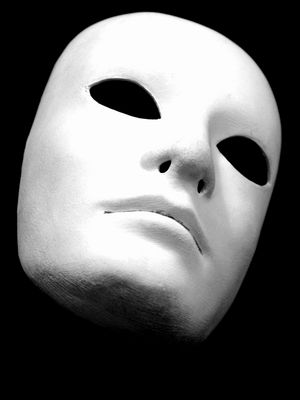
White Mask 
The iconography I will be including in my thriller would be of a white mask. We chose to use a white mask because it contrasts his clothing which emphasises the the use of his hidden identity and that he is more alive when the mask is on. This also establishes to the audience that he is the antagonist and he shouldn't be trusted because he cannot even show his identity when he is in the forest. The reason why in the beginning when he is laying on the floor he is not wearing his mask, but it'll be next to him is to draw the attention of the victims. If he was to be laying on the floor wearing his mask, no one would approach him as it is kind of strange. But we decided if he was to just only wear his mask when he is actually chasing after his victim this will suggest that he uses the mask as a trap to pull the protagonists in. 
Furthermore because we are including a flashback in our opening, the setting of this will be at a park because the little boy will be sitting on the swing. We chose this because parks are seen as places of happiness and joy specially for children as they play in there, however the little boy shown will look quite depressed.

Costumes & Make up

Dark clothing 
The costumes which I will use for the two girls is that they're dressed in dresses and heels as they are coming from a night out as its one of their birthdays. This exaggerates their vulnerability as they're not sober and not fully aware of what they're doing making them an easy target for the antagonist to kill them. In contrast, the boy will bed dressed in informal, scruffy dark clothing to represent his lack of life inside of him and that he is evil and dangerous. As his clothing is dark, he would almost be camouflaged to the dark setting as the lighting will be low-key because this will be shot in the evening. This suggests he would be hard to find creating suspense and tension when it comes to the chase scene. As the girls are coming from a night out, they're make up will be quite outgoing to show that they've come from an informal event. This will make the audience relate to them and sympathies with them because they have just been having a really nice time and now they're going to be apart of a unfortunate situation because this is a thriller. Also, I will be using fake blood to convey the injuries that have occurred on the victims due to the antagonists actions. As Ella is quite artistic, she will also add some bruises made from makeup to exaggerate the killing of the antagonist. 

Facial expressions and body language 

The importance of having valid facial expressions and body language in my scene is that because it'll enhance the scene to be more realistic so that the audience can build a relationship or relate to the characters. When the antagonist is laying on the road, his facial expressions and body language would be dead like as if he was spared out and not engage of what is going on around with him. This is will exaggerate his out place in the setting and that he is quite abnormal. The audience will feel curious of why he is not moving and why he is laying still creating suspense when the protagonist walks over to him because they do not know what he may be capable of and if he is sane. However, contrasting the antagonist, the two girls will have cheerful, happy facial expressions so they'll be smiling and laughing about their night out. They're body language will be quite unsteady as they have been drinking so they're lack of stability may worry the audience and sympathies them as they are in a vulnerable state. This is conventional to a thriller as the victims are usually seen as fully of life and quite adventurous however the suspect antagonist may look reserved and alone.In our flashback, even though we do not see the little boy's face as his back is turned to the camera, his body language will be slouchy with suggests that this little boy is not happy. This is conventional to a thriller as it'll make the audience question why he looks upset making them build a closer relationship with him as children are innocent and young. 

Lighting & Colour

Night time - Black, gloomy 
The lighting we will be using in our thriller scene will be low-key lighting because the major setting will be shot in the evening. As it will be low key lighting this will make it harder for the audience and the victims to see whats around them, creating suspense and enigma as they do not know what may happen. Also this will magnify the deserted area the characters are located meaning that if anything was to happen to them, no one would be able to help the victims quickly. The colours that I will be using are dark colours e.g black, brown. These colours will be what the antagonist is wearing showing how dark his personality is and how he has no emotion or feelings towards his victims. This is conventional to a thriller because the use of the colours helps the antagonist not be seen in the scene as he almost camouflages with the dark setting. However in the flashback we will use a filter which will be black and white to establish to the audience that this is not in the present day. We picked the colours black and white because they're both bland simple colours. Even though the white represents life,light, goodness, innocence when it is used with the colour black which associates with death,night,power and mystery, the two together confuses the audience and makes the think whether the flashback is a good or bad one. This is conventional to a thriller as the colours help build the suspense in the audience because they're unaware of whats going to happen so it'll provoke the shock element when they finally do see the point of the black and white filter. 

Positioning of the characters

Positioning within a drama is a key convention of mise-en-scne as it draws out attention to an important character or object e.g photographer may use positioning to show relationships between people. In my sequence there will be a various number of positioning that my characters will be in to help convey the narrative more interestingly. Firstly, at the beginning the antagonist will be positioned in the middle of the road laying down, this will create suspense as it is quite abnormal to be laying on a road. Secondly in the flashback showing the little boy on the swing, he will be positioned in the middle of the frame, this will emphasise the fact that he is alone. This is conventional to a thriller especially when they include children in the scene as it creates suspense and tension because it makes the audience wonder why a child is alone in the first place. It also makes the audience feel on edge as they do not know what the child might do next as he is just sitting there on the swing. Lastly, at the end of the scene it'll show the girl who has tripped over and fallen onto the ground in the forest looking up ahead of her pathway looking at the antagonist who is standing further away but in her way. The different levels that the two characters in show how powerful the antagonist in the situation and how weak the victim is and she is looking up to him. This will create tension and enigma because the girl is injured and is on the floor but the boy is standing right in front of her, this makes the audience feel tensed and build a closer relationship with her as they do not know how the girl is going to escape as she is in a vulnerable position, sympathising with her. This is conventional to a thriller because it shows the different power statuses between the antagonist and his victims which makes the audience kind of lose hope of the victims getting away.


Planning for the mise-en-scene that me and my group will include in our thriller sequence was helpful as it allowed us to share and conclude the final elements that'll use to make our opening scene successful and conventional to the thriller genre. Mise-en-scene we have decided to include will help create emotions within the audience as it highlights and shows how the characters are feeling and where they are which makes them engage more to the film. I believe that the elements of mise-en-scene we have selected are conventional to a thriller as they help build all the aspects together to create an apprehensive, tensed thriller opening. Also the audience can relate to them making them put themselves in the characters shoes increasing the fear they're feeling which is the whole purpose of a thriller. 

Planning Sound - Miss Miller

Brief plan of sound

Sound is very important in films as it is a combination of diegetic,non-diegetic etc. sounds that influence the affect of the film and how the audience feels about the characters.  Planning for my sound is important to do as it allows me to start thinking about what different types of sound techniques I will be using in my thriller opening, that'll help the audience engage, relate and feel towards the film. If I was to not plan or have an idea of what I'm going to include in my opening scene, when it comes to actually editing it, it will be very time consuming and chaotic as I will be deciding the shots on the spot and members of the group may differ with they're own opinions. Also this may affect my actual editing skills as I will be rushing and panicking on what sound techniques to include. This would be a lack of organisation and in order to create a successful finished thriller opening, I will need to know a structure that I'll be following.

Diegetic sound

Firstly the diegetic sound I will be using in my thriller will be of dialogue between the two girls who are talking throughout the parts where they are walking down the pavement. The use of this sound maintains the sense of normality in the scene, building tension within the audience as they start to think something sinister is about to take place. It also helps build a closer relationship with the characters as they are talking which shows reality and that the audience can relate to what they're doing. Dialogue is conventional to a thriller as it helps build the narrative as well as make it more interesting because it tells the story from the characters perspectives. If there was to be no dialogue in a film it'll be very strange and weird when action does happen because the audience would not understand the reason of it. The second diegetic sound would be when theres a phone conversation happening between one of the girls and the other person on the line. Again this shows the sense of normality in the scene but also creates curiosity and tension as the audience do not know who she is talking to.

Non-diegetic sound

A non-diegetic sound is simply the opposite of a diegetic sound and I'll use a soundtrack of an orchestra piece when the protagonist is running away from the antagonist in the forest. The music used will help build suspense and tension within the audience also a sense of foreboding because it'll mirror the chase scene happening. The use of this music will help build a relationship with the character as it makes the audience feel apprehensive about whether she survives and gets away from the antagonist. The use of this sound will represent the chase scene as it'll get quicker showing the closer that the antagonist is getting closer to his victim making the audience build a sympathetic relationship with the girl. Another non-diegetic sound I will use will be a sound that alerts the audience and makes them jump. This will happen when the antagonist wakes up from his flashback and it'll be heard the exact time his eyes open. We decided to do this as it'll exaggerate his wake and also make the audience feel on edge as it is no expected to occur. As the sound is alerting, it slightly threatens the viewers as well as shocks them because of its unexpected approach. This will suggest to the audience that the boy on the floor, is someone to be scared about as his wake was quite startling, creating a distant relationship to him as they need to be aware of what his going to do next. This particular sound is conventional to a thriller as it alerts the audience on what is happening and shocks them, also emphasises what is happening in the scene making the audience want to carry on watching. 

Parallel sound

We decided to include parallel sounds that the audience would expect to here, firstly we would use this when the two girls are the bus stop as the audience will here car noises in the back ground. The use of this gives the audience an idea of the surroundings that the girls are at and makes the scene more realistic and relatable. The sound helps create a closer relationship with the two girls as they can relate on what ever happens to them due to the normality of their destination. Another parallel sound I will include is the rustling of leaves and breaking of sticks in the forest, this will happen when the girl is running away from the antagonist in the forest. The purpose of this sound is to emphasise where she is located and also each stick that is broken could represent the time she's got left as she is being chased by the antagonist creating a closer relationship between her and the audience as they would want her to get away from him as far away as possible. The use of this sound is conventional to a thriller as it helps clarify where the character is as the sound is what the audience expect to hear in that kind of environment. 

Off Screen sound

A off screen sound is self explanatory in it name anyway, it simply means that a certain noise happens off screen where the audience doesn't see it. The off screen sound I will have in my opening thriller is when the girl is screaming as she gets killed by the antagonist. This would effect the audience because they wouldn't see the actual event happen it'll shock them as they do not know where the screaming is coming from making them jump when they suddenly hear it. The use of this off screen sound will alert the audience that something bad has happened to the girl as she is screaming, this will make them draw more attention to the scene as they'll want to figure out where the screaming is coming from. This is conventional to a thriller as screaming is always used to show that someone is in need of help or is being hurt by someone, this increases the audiences tension and suspense as they want to figure out who it is. In addition, the second off screen sound I will have in my scene will be dialogue in the flashback from a woman who is calling the boy who's on the swing. The use of this will make the audience think and wonder who the voice belonged to and what status she had to the boy creating suspense and tension as the viewers don't know where its coming from either. Also the sound helps give the audience an insight of the antagonist's childhood without them knowing, this will draw their attention and make them want to carry on watching to find out what has triggered the antagonist to be the way he is. Off scene dialogue is conventional to thriller as it creates suspense and tension due to the fact that the viewers do not know where it is coming from, also could suggest that the person who is talking is evil as they're not been shown on the screen. 


Planning the sound for our thriller opening helped us gather ideas that we thought would be effective creating emotions and reactions from the audience that'll make them want to carry on watching. I believe that the sound effects we have chosen will help make our thriller successful as they all do something to the audience, whether its making them jump, feel tenses or creating suspense, it all makes the actual scene more interesting to watch. When editing the scene I will look back on this post to help me understand more about the sounds I decided to include in the final piece. 

Planning Cinematography - Miss Miller

Brief plan of cinematography

Cinematography is very important in films as it is a combination of camera shots,angles and techniques that influence the affect of the film and how the audience feels about the characters. It is also the act of capturing photographic images in space through the use of a number of controllable elements. These include the quality of the film stock, the manipulation of the camera lens, framing, scale and movement. Planning for my cinematography is essential to do as it allows me to start thinking about what different types of camera shots I will be using in my thriller opening, that'll help the audience engage, relate and feel towards the film. If I was to not plan or have an idea of what I'm going to include in my opening scene, when it comes to actually filming it, it will be very time consuming and chaotic as I will be deciding the shots on the spot and members of the group may differ with they're own opinions. Also this may affect my actual camera performance as I will be rushing and panicking on what shots,angles or techniques to include and the actual outcome wouldn't be the best it can be. This would be a lack of organisation and in order to create a successful thriller opening, I will need to plan what I will be doing in able to make the work atmosphere calm but also the shots to be at the best they possibly can. 


Two Shot


Two shot - 'The shining' 
A two shot is a shot which consists of showing only two people clearly, this is usually used in interviews or when two presenters are hosting a show etc. Two shots help establish a relationship between to subjects, as they have an equal appearance in the frame. This could imply that the two people will provide a equal input in this scene but this does not always apply as one person could be dominate in the situation and the other could be following. Also, a two shot could be include a moving object or action, this helps the audience follow the interaction between two people without getting distracted by their surroundings. When creating my own thriller opening scene, I will use a two shot to show my two girls having a conversation at the bus stop about how they'll be getting home that night. I decided to include this specific shot when the two girls are together, as it shows fully what they're wearing and the body language & facial expressions they're expressing. Furthermore, the shot will capture the audiences attention as they'll be analysing the conversation between the two characters, with no distractions from the setting as there is only two people to focus on. In result, once the audience fully understand whats been said by the two girls at the bus stop, as one of them suggests to walk instead of waiting for public transport to get home, this alerts the audiences minds as they know what type of film they're watching and two girls walking home at night is not safe at all. This creates a closer relationship between the audience and the girls because of they're vulnerability and innocence, they know they'll be in danger if they're to walk home alone at night, so they would want nothing to happen to them. This shot is also conventional to a thriller, as it creates suspense and tension for the audience because they've gathered important information that could foreshadow what could happen later on the film. 


Panning

Panning
A panning shot is where the camera movement moves horizontally left and right about a central axis e.g follows a moving object. This is usually mounted in a fixed location on a tripod or shoulder, rather than a dolly-like movement in which the whole entire system moves. This technique helps the audience see what the setting is and helps follow the moving objects that are occuring in the frame. When creating my own thriller opening, I will include panning when both girls are walking down the street. This will grab the audiences attention and make them follow where theyre going, natrually making them watch every move they make. This if effective as it helps build tension as the audience expect something to happen that'll make them jump. Furthermore, the audience can relate to the characters as they subconsciously think that the same thing that may happen to the victims may happen to them which creates a sense of terror for the viewers. As panning shows the setting the characters are in, mine will be of the girls walking down a dark, isolated street to convey that they're alone and if anything was to happen no one could save them. This builds a relationship with the two girls, as the audience are in the beginning forced to focus on them, which could foreshadow that they're in danger so the audience will sympathise them. 

Extreme close up

Extreme close up of the characters eyes
In the original planning that we created(shown above at the top of the post) we put down close up instead of extreme close up. We decided to change this due to the dramatic effect the extreme close up has on the audience. A extreme close up shot is when a certain feature or part of a subject takes up most of the frame. When it is a close up for a person it usually means a close up of their face this emphasise their emotional state showing their facial expressions with conveys emotion. However, in a extreme close up, it generally magnifies beyond what the human eye would experience in reality.This makes the audience drawn into the subject's personal space and shares their feelings. In my opening thriller I will use an extreme close up when the antagonist opens his eyes, waking up from his flashback of a glimpse of his childhood. To support this I will include a loud sound to emphasises the impact of him waking up, this will provoke shock and suspense as the audience and the girls do not know what the antagonist is going to do next. This camera shot will be conventional to a thriller as it makes the audience draw attention to the facial expressions of the antagonist which help convey how his feeling and create suspense within the audience as they don't know whats going to happen next. As his facial expression through his eyes will be furious, this will portray anger and will shock the audience making them feel uncomfortable when they see him as they do not know why his angry and what his going to do to the girl who's just walked over to him. Also it'll have a dramatic effect because it is very artificial and it will make the viewers feel quite threatened as the frame is taken up by the characters eyes, creating a distant relationship with him as they feel he cannot be trusted.


Handheld shot

A Handheld shot is when the camera is held by hand to create a more "home made" or dramatic feel to a shot. This shot often has a jerky feel and also makes the audience feel as their part of the scene, rather than viewing it from a detached, frozen position. In my thriller scene, I will include a handheld shot when the girl who's just witnessed her friend dead on the floor,is running through the forest to get away from the antagonist and scene. This will make the audience put themselves in the action as the shot makes them view the victim running. To accompany with this shot, they'll be a realistic heavy breathing sound, to show the urgency and importance of her running away from this stranger. Also, the sound is efficient as it makes the scene look more realistic, so the audience will be able to relate to the girl running and pay more  attention to whats to come next. This technique will automatically help build a relationship with the character as the audience will feel that they're apart of the scene making them feel tensed and scared like the protagonist does. This is conventional to a thriller as it allows to create suspense, tension and shock as it helps put the audience in the characters perspective making them engage more to the scene and build a closer relationship to her as they would want her to get away from the antagonist as far as possible. 


P.O.V (point of view) shot

Woman protecting her children
A point of view shot is simply a shot that shows a view from the subject's perspective, showing what the character is looking at which is represented through the camera. This shot is very effective as it allows the audience to be put in the characters place and relate to them which makes them more engaged and alert of what is going to happen.  In my opening thriller I will use a point of view shot from the antagonists perspective when he is standing in the way of the girl in the forest. This will help establish to the audience that he is the antagonist as from his point of view we can see the girl screaming which means that she is very scared of him. Also this will help create a closer relationship with the victim as she is seen from his view petrified, the audience can relate to her emotion and connect with how she's feeling through this technique. Moreover , the use of this shot will create suspense and tension as you do not know what the character behind the camera is going to do next making the audience feel on edge. A point of view shot is conventional to the thriller genre as it builds up tension because you do not know who the person who's viewing the scenery is as the camera is set from their perspective and also what is going to happen to them.
Long Shot

Boy walking through forest
This is a shot that shows the full entire human body, with the head near to the top of the screen and feet near to the bottom. Not only does this shot focus on the character, it also shows plenty of the background detail of where that person is in. When creating my own thriller I will use a long shot when the dark figure, antagonist is standing in the way of the protagonist in the woods. As this will be shown from the protagonist perspective it will shock the audience as I will also use the same sound effect that was used when the antagonist was waking up, to link them together and help the audience establish that the dark figure is the boy who was laying down. Moreover this will have an impact on the audience as they'll feel suspicious and tensed on why the boy is going after the girl, making them emphasise the protagonist in the situation, building a closer relationship with her and                 rooting for her to find her way out of this chase.


Planning cinematography as a group was very helpful as it allowed each and every one of us to express our own ideas and convey which ones would be perfect to make our thriller opening successful. The shots we used help show the different perspectives from both our characters i.e point of view from the antagonist looking at the protagonist in the woods. This shows the massive contrast of power between the two character representations as the protagonist is running whilst the antagonist is just standing there. This is very effective as it will make the audience relate to the protagonist making them feel fearful. Furthermore, in our plan we have selected a good amount of techniques that will help provoke the elements of a thriller: suspense, shock and surprise within our opening scene. I believe that if we included the shots correctly, our opening scene will be conventional to a thriller as the cinematography helps create enigma as well as the three main S's which makes the film seem more interesting for the audience to carry on watching to solve the mystery. I found that planning was very essential to preparation of filming our sequence as it allowed us all to share our own ideas that will fit perfectly with our narrative. Also this post helps to give us a guideline of what to do and include when filming so when actually creating our sequence it wont be to chaotic and everyone will know what they're doing, so I will definitely refer back to this post in the future to remind myself what to include.